

![图片[1]-显示控制器QLab Pro 5.6.1 MacOSX-乐声音频-资源网](https://lsypstudio.com/wp-content/uploads/2026/06/image-2026-06-21T225727.073-300x300.jpg)
QLab 5.x Pro Bundle | MacOSX | 18.3 MB
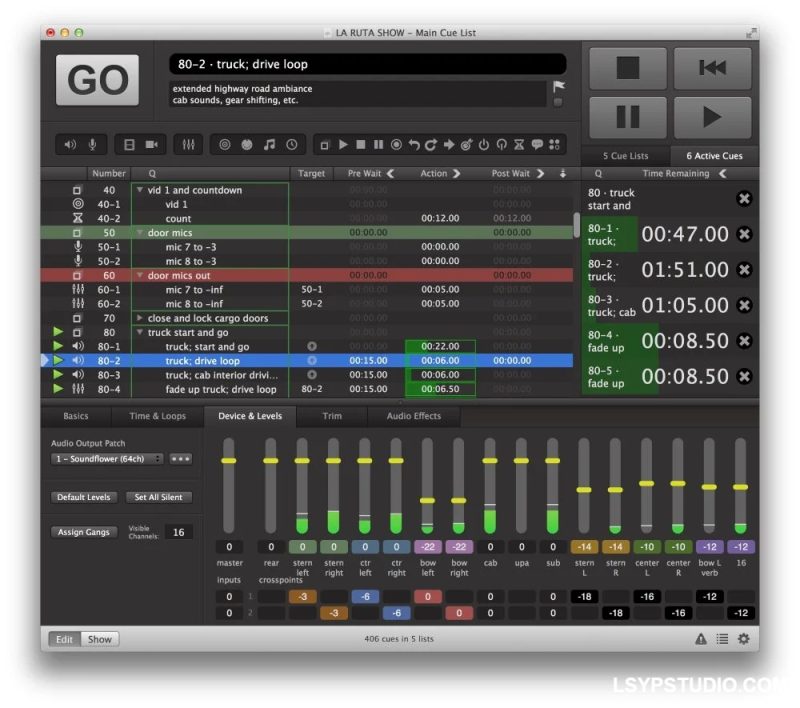
一款优秀的显示控制器。QLab Pro Mac破解版提供了所需的工具和功能,可以创建复杂的设计,使您的音频和视频内容生动起来。您可以在几秒钟内创建复杂的设计。入门简单,只要拖动一个文件中,按“GO”。从那里,添加命令淡出音量,动画视频,或添加音频和视频效果。
QLab为您的Mac提供现场演出控制。可创建适用于戏剧、舞蹈、作曲、装置艺术等领域的媒体设计。您可以在一个工作区中播放音频、视频和MIDI。QLab 4包含全新的灯光提示、对iOS版QLab Remote的重大更新,以及40多项其他新功能。
设计工具
– 无限个带有无限个提示的提示列表
– 无限数量的提示车,每辆车有1到64个按钮
– 在编辑模式下设计,在展示模式下运行你的表演
– 非破坏性设计工具永远不会修改您的媒体文件
– 撤销所有编辑
– 在本地提示“试听”,而不会向舞台发送音频、视频或灯光输出
– 提示模板和工作区模板
– “录制提示序列”工具,用于捕捉时间,并在之后以相同的方式重新播放
– “粘贴提示属性”工具,用于在工作区中选择性地从一个或多个提示中粘贴属性到其他提示上
– 提示列表和提示购物车的文本搜索
– 丰富的AppleScript和OSC应用程序编程接口(API)
– 一个全面的状态窗口,用于指导故障排除
– 通过QLab Remote实现强大且便捷的远程编辑
照明
– 控制无限的Art-Net DMX宇宙。
– 创建无限数量的灯光工具(类似于通道,但可以随意命名,而不仅仅是数字)。
– 创建无限个灯光组,将相关设备集中在一起,如“全部”、“舞台右侧”、“LED灯”、“地面”或“地面左前”。
– 既可使用传统调光器,也可使用具有多个参数的更复杂灯具(包括支持基于百分比的参数,以及8位和16位直接DMX参数。)
– QLab风格的层次渐变:轻松构建可分层和重复使用的外观和效果。灯光提示仅更改你在提示中设置的层次,其余部分保持不变。
– 通过将灯光提示串联起来,用更简单的部分构建出复杂的提示序列,然后像多米诺骨牌一样,用一个简单的“GO”指令触发整个序列,从而打造出精妙的灯光设计。
– 与QLab中的所有提示一样,灯光提示可以随时进行复制、粘贴、重新排序、暂停、恢复和停止
– 所有QLab渐变曲线均可用于灯光提示;包括线性渐变、S形渐变或完全自定义形状的渐变。
– 使用灯光仪表板查看并调整所有灯光的当前亮度。
– 如果您需要从控制面板中悄悄加入实时编辑,您可以选择告诉QLab“随时间”应用新值,这样它们会逐渐平滑地加入。
– 打开试听窗口,在仪表板上“盲”视灯光提示的效果。关闭试听窗口后,仪表板将立即恢复显示灯光的实时状态。
– 调整仪表板上的灯光,然后:
-仅用这些更改创建一个新的提示,
-用所有乐器创建一个新的提示,
-根据更改更新上次运行的光效提示,或者
– 追踪每个最近修改过的乐器的每个提示的编辑记录。
– 将您最喜爱的MIDI控制器映射到灯光指令,以便编辑灯光控制面板或单个灯光效果。
– 对于电动MIDI硬件,QLab支持来自灯光控制面板和单个灯光提示的MIDI“反馈”(即“飞行推子”)
– 利用QLab强大的灯光命令语言,包括自动补全、仪器或组参数寻址、范围、临时组和命令历史记录,高效编辑灯光控制面板和单个灯光提示。
– 随时将灯光提示显示为滑块、图块或原始命令文本。
– 以滑块或互动图块的形式查看Light Dashboard。
– 通过键盘输入(在命令行上)或使用鼠标(通过点击和拖动)来编辑灯光
– 可以轻松地从任何提示中删除单个灯光指令,当然也可以撤销任何编辑。
– 在滑块视图中,将组命令展开为组中当前所有的单个乐器。
– 在滑块视图中,指示器显示提示中每个灯的当前实时值。
– 在滑块视图中,选择多个命令以暂时将它们“组合”在一起,这样你就可以一起向上或向下调整它们。
– 快速查看一组乐器是全部设置为同一音量还是混合了不同的音量。
– 通过选择多个灯光提示,然后只需编辑它们共有的任何灯光命令,即可批量编辑这些灯光提示。(或者一次为所有灯光提示添加新命令。)
– 使用AppleScript,无论是外部使用还是通过脚本提示,以实现高级编程技术,如通过算法生成一系列灯光提示。
– 通过OSC消息控制Light Dashboard和单个Light提示。
音频
– 支持多达64个音频输出通道
– 支持多达24通道的音频文件
– 支持多达24个实时音频输入通道
– 音频波形视图
– 无限次循环播放和编辑您的媒体文件片段
– 跨多个提示的样本级精确播放同步
– 音频平移和音量渐变
– 自定义输出通道名称
– 编辑音频设备路由
– 任何提示上的音效
– 提示输出上的音效
– 设备输出上的音频效果
– 动态淡化音频效果
QLab provides live show control for your Mac. Create media designs for theatre, dance, composition, installation, and more. Play back audio, video, and MIDI from a single workspace. QLab 4 includes an all-new Light cue, a huge update to QLab Remote for iOS, and over 40 other new features.
Design Tools
– Unlimited Cue Lists with unlimited cues
– Unlimited Cue Carts with 1 to 64 buttons per cart
– Design in Edit Mode and run your performance in Show Mode
– Non-destructive design tools never modify your media files
– Undo any edits
– “Audition” cues locally without sending audio, video, or lighting output to the stage
– Cue templates and Workspace templates
– “Record cue sequence” tool, to capture timing and play it back again the same way later
– “Paste cue properties” tool, to selectively paste properties from one or more cues onto other cues in your workspace
– Text search of cue lists and cue carts
– Extensive AppleScript and OSC APIs
– A comprehensive Status Window to guide troubleshooting
– Powerful and painless remote editing via QLab Remote
Lighting
– Control unlimited Art-Net DMX universes.
– Create unlimited light instruments (like channels, but can be named anything, not just numbers).
– Create unlimited light groups to collect related instruments together, like “all”, “stage right”, “LEDs”, “floor”, or “floor front left”.
– Use both conventional dimmers and more complex lights with multiple parameters (includes support for percentage-based parameters, as well as both 8-bit and 16-bit direct DMX parameters.)
– QLab-style levels fading: it’s simple to build looks and effects that you can layer and reuse. A Light cue changes only the levels you set in the cue, and leaves the rest unchanged.
– Build sophisticated lighting designs by chaining Light cues together to build complex cue sequences out of simpler parts, then trigger the sequence with a single “GO” like a chain of dominoes.
– As with all cues in QLab, Light cues can be copied, pasted, reordered, paused, resumed, and stopped at any time
– All QLab fade curves are available for Light cues; including linear, s-curve, or totally custom shape fades.
– See and manipulate the current levels of all your lights using the Light Dashboard.
– If you need to sneak in live edits from the Dashboard, you can optionally tell QLab to apply the new values “over time” so they’ll fade in smoothly.
– Open the Audition Window to view the effects of light cues “blind” in the dashboard. Close the Audition Window, and the dashboard will instantly revert back to show the live state of your lights.
– Adjust your lights in the dashboard, then:
-Create a new cue with just the changes,
-Create a new cue with all instruments,
-Update the last-run light cue with the changes, or
– Trace back the edits to each cue that most recently modified each instrument.
– Map your favorite MIDI controller to light commands, for editing either the light dashboard or individual cues.
– For motorized MIDI hardware, QLab supports MIDI “feedback” from the light dashboard and individual light cues. (Aka “flying faders”.)
– Use QLab’s powerful light command language, with autocompletion, instrument or group parameter addressing, ranges, ad-hoc groups, and command history, to efficiently edit both the light dashboard and individual light cues.
– View light cues as sliders, tiles, or raw command text at any time.
– View the Light Dashboard as sliders or tiles.
– Edit lights via keyboard entry (on the command line) or with the mouse (via clicking and dragging.)
– Easily delete individual light commands from any cue, and of course undo any edits.
– In slider view, expand group commands into all the individual instruments currently in the group.
– In slider view, indicators show the current live value of each light in a cue.
– In slider view, select multiple commands to temporarily “gang” them, so you can adjust them up or down together.
– Quickly see when a group of instruments is set to all the same level or a mix of different levels.
– Batch-edit multiple light cues by selecting them and then simply editing any light command they all share. (Or adding a new command to all of them at once.)
– Use AppleScript, either externally or via Script cues, for advanced programming techniques like algorithmically generating a series of Light cues.
– Control both the Light Dashboard and individual Light cues via OSC messages.
Audio
– Support for up to 64 channels of audio output
– Support for up to 24-channel audio files
– Support for up to 24 channels of live audio input
– Audio waveform view
– Unlimited slices of your media files for looping and vamping
– Sample-accurate playback synchronization across multiple cues
– Audio panning and volume fading
– Customize output channel names
– Edit audio device routing
– Audio effects on any cue
– Audio effects on cue outputs
– Audio effects on device outputs
– Fade audio effects dynamically
Video
– Full-screen or custom geometry for Video cues
– Fade and animate videos
– 1000 layers of video
– Masking and edge-blending across multiple projectors
– Warping and keystone correction
– Basic video effects
– Live camera input with the Camera cue
– Syphon input & output
– Blackmagic input & output
– Text & titles with the Text cue
Show Control
– Send OSC or UDP messages using the Network cue
– Fade your OSC messages over time, in 1D or 2D
– Inject live values from your workspace into outgoing OSC messages
– Send all MIDI and MIDI Show Control messages with the MIDI cue
– Send MIDI messages by playing MIDI files with the MIDI File cue
– Run your own AppleScripts with the Script cue
– Generate LTC or MTC output with the Timecode cue
– Trigger cue lists from incoming LTC or MTC timecode
– Remote control via OSC and MIDI
Requirements: Intel, 64-bit processor OS X 10.10 or later
Home Page – https://figure53.com/qlab
![多频段贝斯合成器UVI Rumble v1.0.1 U2B [MacOSX]-乐声音频-资源网](https://lsypstudio.com/wp-content/uploads/2026/06/image-2026-06-28T222016.359-800x592.jpg)

![乐器均衡器Final Mix Software WESTLAKE EQ III v3.0.3 [WiN, MacOSX]-乐声音频-资源网](https://lsypstudio.com/wp-content/uploads/2026/08/image-2026-08-07T221527.916-800x215.jpg)
![为您提供直接从录音中学习您喜爱的歌曲并高效练习的工具Aurally Sound Song Master PRO v5.0.02 [WiN]-乐声音频-资源网](https://lsypstudio.com/wp-content/uploads/2026/08/下载-6-1-800x512.jpg)

![母带处理-LANDR Mastering Plugin PRO v1.1.35 U2B FIXED [MacOSX]-乐声音频-资源网](https://lsypstudio.com/wp-content/uploads/2025/12/image-520.png)
![MIDI 音序器S1gns Of L1fe Stellarizer v0.9.0 BETA [WiN]-乐声音频-资源网](https://lsypstudio.com/wp-content/uploads/2026/08/image-2026-08-02T092316.832-800x450.jpg)
![DDMF Virtual Audio Stream v2.0.2 x32 x64 WiN Rev5 [WiN]-乐声音频-资源网](https://lsypstudio.com/wp-content/uploads/2026/07/image-2026-07-27T181536.537.jpg)
![高级混响处理工作站Cloudy Samples Cyberverb RETAiL [WiN, MacOSX]-乐声音频-资源网](https://lsypstudio.com/wp-content/uploads/2026/08/image-2026-08-09T084613.681-800x800.jpg)
![Kush Audio Bundle v2025.11 [U2B] [MacOSX]-乐声音频-资源网](https://lsypstudio.com/wp-content/uploads/2025/12/image-551.png)
![oeksound soothe2 v1.3.3 [U2B] [MacOSX]-乐声音频-资源网](https://lsypstudio.com/wp-content/uploads/2025/12/image-549.png)